7 min read
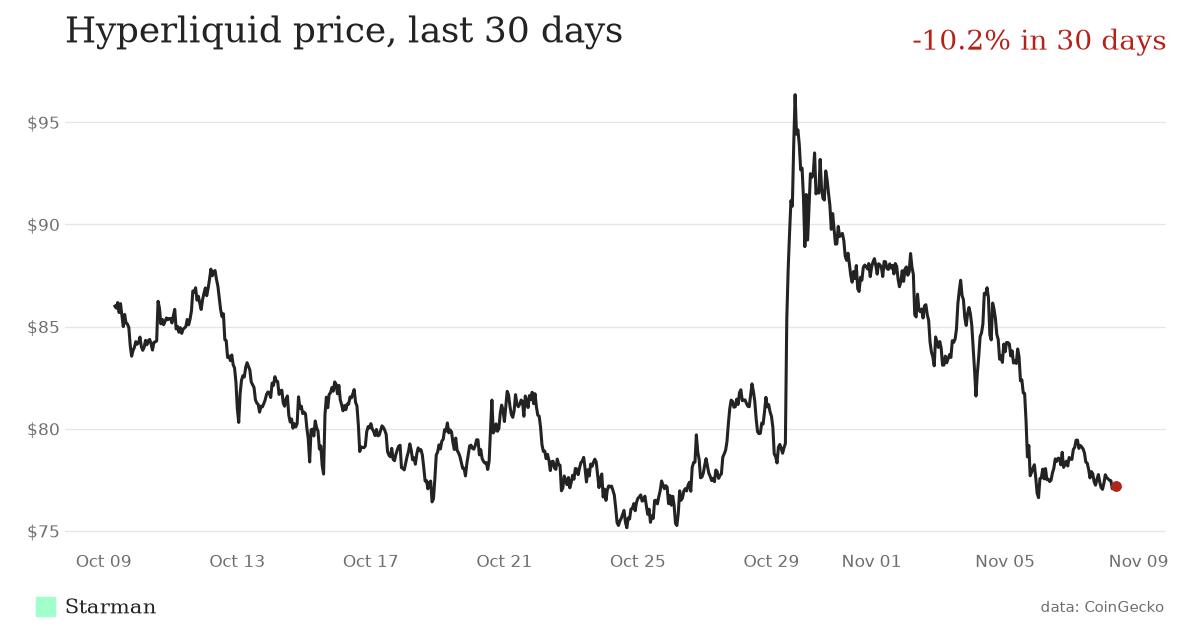
Hyperliquid’s HYPE trades at $77.16, about 21% below its $97.96 all-time high, according to CoinGecko. If you’re asking what is Hyperliquid and why it keeps showing up on trending lists, the short answer is that it’s a blockchain built mainly to run a futures exchange, and HYPE is the token that pays for, secures and governs that chain. It’s also down 12.23% this week, so this is a good moment to understand it before doing anything.
Key takeaways
- HYPE is ranked #11 by market cap on CoinGecko at $77.16, roughly $18.5 billion in circulating value.
- Only about 239.4 million of a 1 billion max supply circulates, around 24%, per CoinGecko supply data.
- The token set its all-time high of $97.96 on September 23, 2026, and is down 10.01% over 30 days (CoinGecko).
- Over one year HYPE is still up 88.01%, even after this week’s 12.23% drop (CoinGecko).
What is Hyperliquid, in plain terms?
Hyperliquid is a layer one blockchain whose main product is a decentralized exchange for perpetual futures, the leveraged contracts that let you bet on a price going up or down without an expiry date. CoinGecko lists it under six categories, including Decentralized Exchange, Derivatives, Perpetuals and Smart Contract Platform. That mix tells you most of the story.
Most decentralized exchanges are apps sitting on top of someone else’s chain, like Ethereum or Solana. Hyperliquid went the other way. The team built the chain around the exchange, so the order book itself lives on-chain instead of in an off-chain server.
Around that core, the project description lists spot trading, borrowing and lending, real world assets and a full Ethereum Virtual Machine (the HyperEVM), which lets developers deploy Ethereum-style smart contracts that can plug into the exchange.
What problem does Hyperliquid claim to solve?
The pitch is simple. Centralized exchanges are fast but you have to trust them with your money. On-chain exchanges are transparent but historically slow and clunky for active traders. Hyperliquid claims you can have both: exchange-grade speed with every order and liquidation visible on a public chain.
The project’s own description compares itself to the move to electronic trading in the 2000s and calls itself a chance for “a massive technical upgrade of the existing financial system.” That’s marketing language, and I’d read it that way. The more grounded version is this: if you’ve ever had an exchange freeze withdrawals, a self-custodied venue with public books is a real improvement. Our piece on the MEXC FinCEN order is a recent reminder of why people look for that.
Whether Hyperliquid fully delivers on decentralization is a separate question, and I’ll come back to it in the risks.
How is the HYPE token actually used?
HYPE is the native token of the Hyperliquid chain. In practice it does a few jobs:
- It’s staked by validators and delegators to secure the network, which is how proof-of-stake chains decide who produces blocks.
- It’s used to pay gas on the HyperEVM side, the same way ETH pays gas on Ethereum.
- Staking it can reduce trading fees on the exchange.
- Part of the exchange’s fee revenue has gone toward buying HYPE on the open market through what the project calls its Assistance Fund.
That last point is the one most HYPE holders care about. It ties the token to trading activity in a fairly direct way: more volume, more fees, more buying. The flip side is just as direct. If traders leave, that support shrinks. I’d treat HYPE less like a general platform token and more like a bet on one exchange keeping its users.
HYPE supply: how much is out there?
This is the part I’d spend the most time on if I were new to HYPE. The circulating supply is small compared to what exists.
| Metric (CoinGecko) | Value |
|---|---|
| Price | $77.16 |
| All-time high | $97.96 (September 23, 2026) |
| 7-day change | -12.23% |
| 30-day change | -10.01% |
| 1-year change | +88.01% |
| Circulating supply | 239,406,814 HYPE |
| Total supply | 951,538,273 HYPE |
| Max supply | 1,000,000,000 HYPE |
| Market cap rank | #11 |
Do the math and roughly 712 million tokens sit in the total supply but outside circulation. Circulating supply is about 24% of the max.
Here’s why that matters. At $77.16, the circulating market cap works out to about $18.5 billion. Price the full 1 billion max supply the same way and you get about $77 billion, more than four times larger. That gap is the fully diluted valuation problem: tokens held for the team, future emissions and community rewards can enter the market over time, and someone has to buy them.
CoinGecko’s data doesn’t tell us the unlock schedule, so I won’t guess at dates. If you’re considering HYPE, look up the official allocation and vesting before anything else.
Why is Hyperliquid trending right now?
Honest answer: the data I have doesn’t show a single headline driving it. There was no specific Hyperliquid news in my sources this week. What the data does show is HYPE sitting at the top of CoinGecko’s trending list, ahead of Bitcoin.
Two things probably explain the attention. First, a 12.23% weekly drop on a top-15 asset gets people searching. Big moves in either direction do that. Second, Kinetiq (KNTQ), ranked #191, is also on the trending list, and Kinetiq is a liquid staking project built on top of Hyperliquid. When a coin and its ecosystem projects trend together, it usually means people are looking at the whole network, not just the price.
The wider market context matters too. Total crypto market cap is about $2.56 trillion and Bitcoin dominance is 59.32%, per CoinGecko. High dominance usually means money is sheltering in BTC while altcoins slide, which matches what we covered in this week’s market roundup. HYPE falling with the alts isn’t surprising in that setup.
What are the risks of Hyperliquid and HYPE?
I’ve lost money on tokens that looked great on the way up, so here’s the list I’d want someone to give me.
Supply overhang
With about 76% of max supply not yet circulating, future unlocks and emissions are a real headwind. A strong product doesn’t protect the price if new tokens arrive faster than demand.
Dependence on one business
HYPE’s value story leans heavily on exchange fees. Perpetual trading volume is cyclical. When the market cools, leveraged traders trade less, and fee-funded buybacks shrink with them.
Decentralization questions
Running a fast on-chain order book means trade-offs, and critics have long argued the validator set is smaller and more concentrated than older chains. Nobody outside the project can fully say how that holds up under stress. Hyperliquid has already faced at least one public dispute over how it handled a manipulated market, and validator intervention in that case worried some users.
Leverage and regulation
Perpetual futures are restricted for retail users in several countries. A DEX offering them without identity checks is exactly the kind of thing regulators look at. I can’t tell you how that plays out, and neither can anyone else yet. Leverage also cuts both ways for you as a user, and fast liquidations are part of how the platform stays solvent.
Smart contract and bridge risk
Funds usually reach Hyperliquid through a bridge, and bridges have a bad history across crypto. If you’re putting money anywhere on-chain, our security checklist is worth five minutes.
FAQ
Is Hyperliquid a blockchain or an exchange?
Both. Hyperliquid is a layer one blockchain, but its flagship product is a decentralized exchange for perpetual futures and spot trading. The chain was designed around the exchange, and the HyperEVM adds general smart contract support on top.
What is the max supply of HYPE?
HYPE has a maximum supply of 1 billion tokens. CoinGecko shows about 951.5 million in total supply and about 239.4 million circulating, so roughly 24% of the max is currently on the market.
Why is HYPE down this week?
HYPE fell 12.23% over seven days and 10.01% over 30 days, per CoinGecko. My sources show no single Hyperliquid-specific headline behind it. The drop lines up with a broader altcoin slide while Bitcoin dominance sits at 59.32%.
What is the HYPE all-time high?
HYPE’s all-time high is $97.96, set on September 23, 2026, according to CoinGecko. At $77.16 it trades about 21% below that level.
What I’d watch next with HYPE
Three things. First, the gap between circulating and total supply: if the 239.4 million circulating figure starts climbing quickly, that’s new sell pressure to account for. Second, whether ecosystem projects like Kinetiq keep drawing attention, because a network with real apps on its HyperEVM is a sturdier story than an exchange alone. Third, Bitcoin dominance. Near 60%, altcoins like HYPE tend to struggle no matter how good the product is.
Hyperliquid is one of the more interesting things built in crypto in the last couple of years, and the 88.01% one-year gain shows the market agrees. That doesn’t make the token cheap or safe. This is not financial advice, so do your own research before you put money in.
Related reading
This article is for information only and is not financial advice. Crypto assets are volatile; you can lose all of your money.