6 min read
The altcoin meaning is simple: any crypto that isn’t Bitcoin, now 40.04% of the market. CoinGecko data puts Bitcoin dominance at 59.96% today. That means every other coin combined, from Ethereum to Dogecoin to dollar stablecoins, adds up to roughly $1.02 trillion of a $2.54 trillion market, and over the past 30 days most of the big ones have fallen two to three times harder than Bitcoin.
Key takeaways
- CoinGecko shows Bitcoin dominance at 59.96%, which leaves altcoins with 40.04% of a $2.54 trillion total crypto market cap.
- Over 30 days Bitcoin fell 8.22%, while Cardano fell 24.63%, Stellar 22.76% and Solana 19.24% (CoinGecko).
- Tether traded $18.43 billion in 24 hours, more than Bitcoin’s $10.62 billion, per CoinGecko.
- Monero is one of the few large altcoins up over 30 days, gaining 11.0% (CoinGecko).
Altcoin meaning: where the word comes from
“Altcoin” is short for “alternative coin.” Bitcoin launched in 2009, and within a couple of years developers were copying its open-source code, changing a few settings and launching their own coins. Litecoin, from 2011, is the classic early example. Anything that was an alternative to Bitcoin got lumped under one word.
Today the term is looser. Most people use it for every token except BTC, whether it runs its own blockchain or lives on someone else’s. Some traders carve out Ethereum, because at $2,238.27 per coin and the number two spot on CoinGecko it’s hard to call it “alternative” anymore. Others leave stablecoins out, since a coin that’s supposed to stay at $1 doesn’t behave like a speculative asset.
When I started in 2017, “altcoin” mostly meant whatever ICO token was pumping that week. The word hasn’t changed, but the list behind it has gotten a lot more varied.
What are the main types of altcoins?
There’s no official taxonomy, but the top 20 coins on CoinGecko right now fall into a few clear groups:
- Smart contract platforms run apps, lending markets and exchanges. Ethereum, Solana ($89.57) and Cardano ($0.180393) are the big names here, and DefiLlama shows Ethereum alone holding $43.34 billion in total value locked.
- Stablecoins like Tether (USDT) and USDC try to track the US dollar. USDT sits at $0.99911, and it’s the most traded coin in crypto by a wide margin.
- Payment-focused coins such as XRP ($1.16), Stellar ($0.150851) and Bitcoin Cash ($246.50) pitch themselves as faster or cheaper ways to move money.
- Exchange tokens are tied to a trading platform. BNB ($697.74), LEO ($9.32) and WhiteBIT Coin ($72.91) all make the top 20.
- Privacy coins hide transaction details. Monero ($601.73) and Zcash ($1,278.57) are both top-12 assets right now.
- Memecoins run mostly on community and attention. Dogecoin ($0.07116) is the oldest; if you want a newer example, here’s our explainer on what PENGU coin is.
A newer group is tokenized real-world assets. Figure Heloc, a token tied to home equity loans, ranks ninth on CoinGecko at $1.066. Whether you call that an altcoin is a matter of taste, but it shows how wide the label has gotten.
How big is the altcoin market right now?
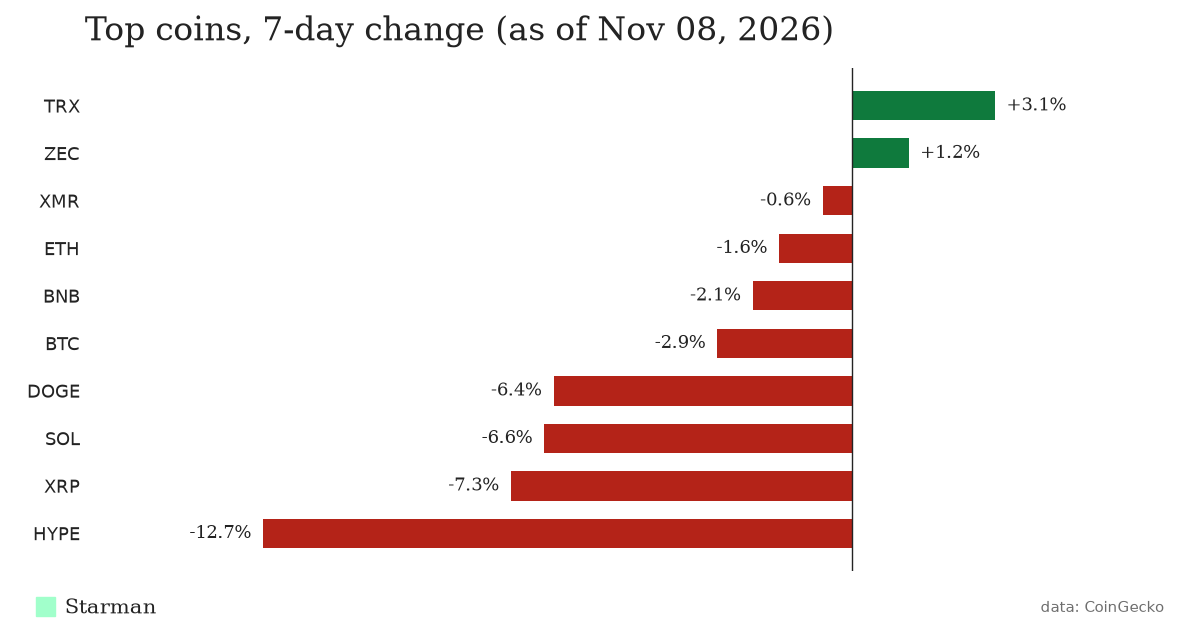
Roughly $1.02 trillion, or 40.04% of the total, based on CoinGecko’s $2.54 trillion market cap and 59.96% Bitcoin dominance. The more useful view is how individual coins are moving compared with Bitcoin:
| Coin | Price (USD) | 7-day change | 30-day change | 24h volume |
|---|---|---|---|---|
| Bitcoin (BTC) | $75,907 | -2.90% | -8.22% | $10.62B |
| Ethereum (ETH) | $2,238.27 | -1.57% | -10.69% | $3.93B |
| XRP | $1.16 | -7.35% | -17.17% | $870M |
| Solana (SOL) | $89.57 | -6.63% | -19.24% | $879M |
| Cardano (ADA) | $0.1804 | -7.24% | -24.63% | $110M |
| Stellar (XLM) | $0.1509 | -11.27% | -22.76% | $80M |
| Hyperliquid (HYPE) | $77.43 | -12.69% | -10.66% | $453M |
| Monero (XMR) | $601.73 | -0.63% | +11.00% | $75M |
| TRON (TRX) | $0.3201 | +3.08% | -3.50% | $276M |
Source: CoinGecko market data, November 8, 2026.
The pattern is hard to miss. Bitcoin is down 8.22% on the month. Most big altcoins are down somewhere between 17% and 25%. For more on how the week played out, see our crypto market weekly recap.
Why are altcoins falling harder than Bitcoin?
Part of it is just how altcoins work. They’re smaller and trade with less depth, so the same wave of selling moves them further. Bitcoin did $10.62 billion in 24-hour volume on CoinGecko. Solana did $879 million and Cardano $110 million. Thinner order books mean bigger swings in both directions.
Leverage made it worse. CoinDesk reported that over $1 billion in bullish bets were liquidated while ETF flows offered no support in the spot market. Forced selling like that usually hits the riskiest corners first, and altcoins sit in that corner.
The category numbers back that up. On CoinGecko’s 24-hour category data, AI Meme tokens lost 7.06% of their market cap and Cat-Themed tokens lost 4.83%. Meanwhile the Synthetic Dollar category gained 5.45% to $7.0 billion. On DefiLlama, stablecoin issuer M0 grew its TVL 39.5% over seven days to $247 million.
My read is that some money is rotating out of speculative tokens into dollar-like assets. Nobody can say yet whether that’s a short pause or the start of something longer.
Are altcoins riskier than Bitcoin?
In general, yes, and I learned that the expensive way. Bitcoin has a fixed 21 million coin cap and the deepest liquidity in crypto. Altcoins come with their own supply schedules, team allocations and unlocks, plus the risk that the project behind them simply loses relevance. Most of the tokens I bought in 2017 don’t trade anywhere today.
Even established names swing hard. Bitcoin Cash, a Bitcoin fork, fell 13.42% in seven days. Hyperliquid’s HYPE dropped 12.69% over the same week despite being the eleventh-largest coin. Our Hyperliquid explainer covers what drives that token.
There are exceptions. TRON is up 3.08% over seven days and Zcash 1.22%, and Monero is up 11.0% over 30 days. Those few gains aren’t a reason to think the whole group is safe, though. They show how different one altcoin can be from the next.
Does Bitcoin dominance tell you when altcoins will rally?
It tells you who’s winning right now, not what happens next. “Altcoin season” is the name for stretches when altcoins outperform Bitcoin and dominance falls. At 59.96%, Bitcoin holds a clear majority, which is the opposite of that.
I’d treat dominance as a thermometer, not a forecast. A sustained drop would mean money is moving into altcoins. A rise means it’s going the other way, often into Bitcoin or stablecoins.
What I’d watch next for altcoins
Three things, all public and free to check:
- Bitcoin dominance against today’s 59.96% on CoinGecko. A sustained move in either direction matters more than one day’s number.
- Stablecoin activity. Tether’s $18.43 billion in daily volume is well above Bitcoin’s, and growth in dollar-like assets such as M0 tells you whether cash is waiting on the sidelines or leaving.
- Chain TVL on DefiLlama. Ethereum holds $43.34 billion, Base $5.87 billion and Solana $5.21 billion. If capital returns to altcoins, these numbers tend to show it before the headlines do.
This is not financial advice, so do your own research before you buy or sell anything.
FAQ
What is an altcoin in simple terms?
An altcoin is any cryptocurrency other than Bitcoin. The name comes from “alternative coin.” Right now altcoins make up 40.04% of the total crypto market, based on CoinGecko’s 59.96% Bitcoin dominance figure.
Is Ethereum an altcoin?
Technically, yes, since it isn’t Bitcoin. In practice, many traders put Ethereum in its own bucket because it’s the second-largest coin and powers most of DeFi. If you see “BTC, ETH and altcoins” in a report, that’s the reason.
Are stablecoins altcoins?
By the strict definition they are, but most people leave them out because they’re built to hold $1 rather than rise in value. That matters when you read market share figures. Tether and USDC sit inside that 40.04% altcoin share, so the speculative part of the altcoin market is smaller than it looks.
What is altcoin season?
Altcoin season is a period when altcoins as a group outperform Bitcoin and Bitcoin’s dominance falls. With dominance at 59.96% and most large altcoins down far more than BTC over 30 days, current data doesn’t look like one. Nobody can reliably time when one starts.
Related reading
This article is for information only and is not financial advice. Crypto assets are volatile; you can lose all of your money.