8 min read
Staking rewards pay you in the coin you stake, and ETH fell 10.37% in the 30 days to Nov 8, 2026. That one fact explains most of what beginners get wrong about crypto staking rewards: the yield is real, but it’s paid in an asset whose price can move far more in a month than the reward adds in a year.
This guide covers what staking is, where the rewards actually come from, how to start step by step, and the mistakes I’ve made or watched other people make since the 2017 cycle.
Key takeaways
- Staking rewards are paid in the staked coin itself, so a 30-day ETH move of -10.37% (market snapshot, Nov 8, 2026) hits your balance’s dollar value directly.
- Solana dropped 19.28% over the same 30 days in that snapshot, a move larger than several years of typical single-digit staking yield.
- Bitcoin, the largest coin at $75,862 in the snapshot, can’t be staked natively because it runs on proof of work, not proof of stake.
- Stablecoins like USDT ($0.999) and USDC ($0.9996) aren’t staked at the protocol level; any yield offered on them comes from lending, which carries different risks.
What is staking in crypto, in plain terms?
Staking means locking up a proof-of-stake coin so it can be used to help secure that blockchain. In return, the network pays you a share of new coins and fees.
Here’s the mechanism. A proof-of-stake chain needs computers (validators) to propose and confirm blocks. Instead of burning electricity like Bitcoin miners, validators put up coins as collateral. If they do the job honestly, they earn rewards. If they cheat or go badly offline, the network can take some of that collateral away, which is called slashing.
You don’t have to run a validator yourself. Most people stake by handing their voting weight to someone who does, either through an exchange, by delegating from their own wallet, or through a liquid staking protocol. Ethereum, for example, asks for 32 ETH to run your own validator, which at the $2,237.41 price in our Nov 8, 2026 snapshot is a little over $71,000. Most people simply don’t have that, so they delegate or pool.
How do crypto staking rewards actually work?
The rewards come from two places, and it matters which one is doing the heavy lifting.
- New issuance. The protocol mints fresh coins and hands them to validators. This is the bulk of the reward on many chains.
- Transaction fees and tips. Users pay to get their transactions included, and part of that goes to whoever produced the block.
That first source is the part people miss. If a network mints new coins to pay stakers, then everyone who doesn’t stake gets diluted. Staking on a high-issuance chain is partly just keeping up with inflation, not getting ahead of it. I’d always ask how much of an advertised rate is printed coins versus fees paid by actual users, because fees reflect real demand and printing doesn’t.
Rewards are then split roughly in proportion to stake. If you delegate, your validator takes a commission first (a percentage of your rewards, set by the validator). Exchanges take a cut too, usually without showing you the gross number.
A simple example of the math
Say a network pays 5% a year (a round number for the math, not a quote for any specific chain). You stake 100 coins. After a year, ignoring compounding, you have 105 coins. If your validator charges a 10% commission, you keep 4.5 of those 5, so you end with 104.5.
Now apply the price. In our Nov 8, 2026 snapshot, SOL was down 19.28% over 30 days. A 5% annual reward doesn’t come close to covering a one-month move like that. Your coin count went up. Your dollar value may not have.
Why the reward rate isn’t your real return
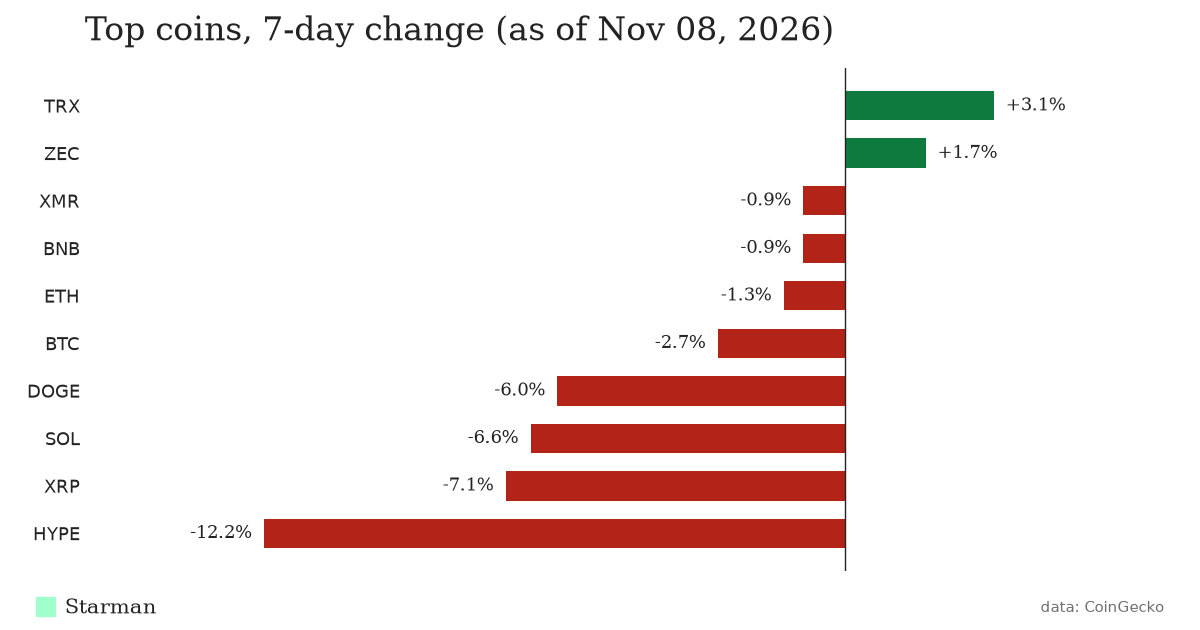
Your actual result is the reward in coins multiplied by whatever the coin is worth when you finally care. The table below shows how much prices moved for large coins in a single month, which is the scale staking yield has to compete with.
| Coin | Price (USD) | 7-day change | 30-day change | Native staking? |
|---|---|---|---|---|
| Bitcoin (BTC) | $75,862 | -2.67% | -8.03% | No (proof of work) |
| Ethereum (ETH) | $2,237.41 | -1.29% | -10.37% | Yes |
| BNB | $699.65 | -0.88% | -5.84% | Yes |
| Solana (SOL) | $89.14 | -6.59% | -19.28% | Yes |
| TRON (TRX) | $0.320375 | +3.11% | -3.51% | Yes |
Source: market snapshot of top coins by market cap, Nov 8, 2026. These numbers will be out of date by the time you read this, and that’s the point. Prices move every week. The structure (reward in coins, risk in dollars) doesn’t change.
So staking makes the most sense for a coin you’d hold anyway. If you were going to keep the ETH or SOL regardless, staking it earns you more of it. If you’re buying a coin because of the staking rate, you’re letting the tail wag the dog.
How to stake crypto, step by step
- Pick a coin you already want to hold. Check that it’s actually proof of stake. Bitcoin isn’t, and anything advertising “BTC staking” is a lending or wrapping product with its own counterparty risk.
- Choose how you’ll stake. Exchange staking is a few clicks but the exchange holds your coins. Delegating from your own wallet keeps custody with you. Liquid staking gives you a receipt token you can move around, at the cost of an extra smart-contract layer.
- Read the unbonding period. Many chains make you wait before unstaked coins become spendable again. During that wait you can’t sell, even if the price is falling. Know the number before you commit.
- Check the validator. Look at commission, uptime, and how much stake it already has. A cheap validator that keeps going offline costs you more than a slightly pricier one that doesn’t.
- Start with a small amount. Stake a test amount, wait for the first reward, then try unstaking it. You’ll learn the real flow before real money is involved.
- Keep records. In many countries, staking rewards can be taxable when you receive them, based on their value at that moment. Save dates and amounts from day one.
If you’re staking through a centralized platform, read our piece on moving crypto when an exchange closes accounts. Staked coins on an exchange can be stuck in an unbonding queue exactly when you need them out.
Exchange staking, delegation, or liquid staking: which fits you?
There’s no single right answer, but there’s a clear trade-off between convenience and control.
Exchange staking is the easiest. You also inherit every risk of the exchange: hacks, freezes, regulatory orders, sudden product changes. I’d only keep an amount there I could afford to have locked for months.
Delegating from your own wallet is what I use for coins I plan to hold long term. Your coins never leave your control; you’re just pointing your stake at a validator. The catch is you’re responsible for your keys, so if you’re new to self-custody, go through a basic crypto security checklist first.
Liquid staking is the most flexible and the most layered. You get a token representing your staked position, which you can trade or use elsewhere. Nobody knows in advance how those receipt tokens will trade during a panic, and some have traded below the value of the coins they represent when lots of people rushed for the exit at once.
Common staking mistakes (some of them mine)
I chased a double-digit staking rate on a small chain in the last cycle. The rate was real. So was the issuance behind it, and the token’s price slid the whole time I held it. I ended with more coins worth less money. That’s the most common mistake by far: treating APY as profit.
The others I see over and over:
- Ignoring the unbonding wait, then trying to sell during a crash and discovering the coins won’t be free for days or weeks.
- Delegating to the validator with the lowest commission without checking whether it’s reliable. Downtime means missed rewards, and on some chains it risks slashing.
- Piling into the single biggest validator. It’s easy, but concentrating stake weakens the network you’re trying to earn from.
- Confusing “stablecoin staking” with real staking. Yield on USDT or USDC comes from lending your coins to someone. That’s a credit risk, not protocol security.
- Forgetting taxes until a year of tiny daily rewards turns into a bookkeeping mess.
If you want to see how a specific proof-of-stake chain works in practice, our explainer on NEAR Protocol walks through one network’s design.
FAQ
Is staking crypto safe?
It’s safer than many yield products, but it isn’t risk free. You carry price risk on the coin, lockup risk during unbonding, slashing risk if your validator misbehaves, and platform risk if you stake through an exchange or liquid staking protocol. The protocol-level part is usually the least of your worries.
Can you lose money staking?
Yes, mostly through price. Your coin count normally goes up, but if the coin falls, as SOL did by 19.28% over 30 days in our Nov 8, 2026 snapshot, your dollar value can drop well below what you started with. Slashing and platform failures are rarer but real.
Can I stake Bitcoin?
Not natively. Bitcoin uses proof of work, so there’s no validator role to stake into. Products that offer “Bitcoin yield” usually lend your BTC out or wrap it onto another chain, which adds counterparty risk.
Are staking rewards taxed?
In many countries, yes, often as income when you receive them and again as a capital gain or loss when you sell. Rules differ a lot by country and change over time, so check your local guidance and keep a record of every reward’s date and value.
What I’d check before staking anything
I’d start by asking whether I want to hold the coin for a year even with zero rewards. If the answer is no, staking won’t fix that. If it’s yes, I’d look up how much of the reward comes from fees versus new issuance, confirm the unbonding period, and stake a small test amount through a method where I control the keys.
After that, I’d check it once a month, not once an hour. Staking works best as a slow, boring way to add to a position you already believe in. For a sense of how prices are moving around you while you wait, our weekly market roundup is a good place to look.
This isn’t financial advice, so do your own research before you lock anything up.
Related reading
This article is for information only and is not financial advice. Crypto assets are volatile; you can lose all of your money.