
7 min read
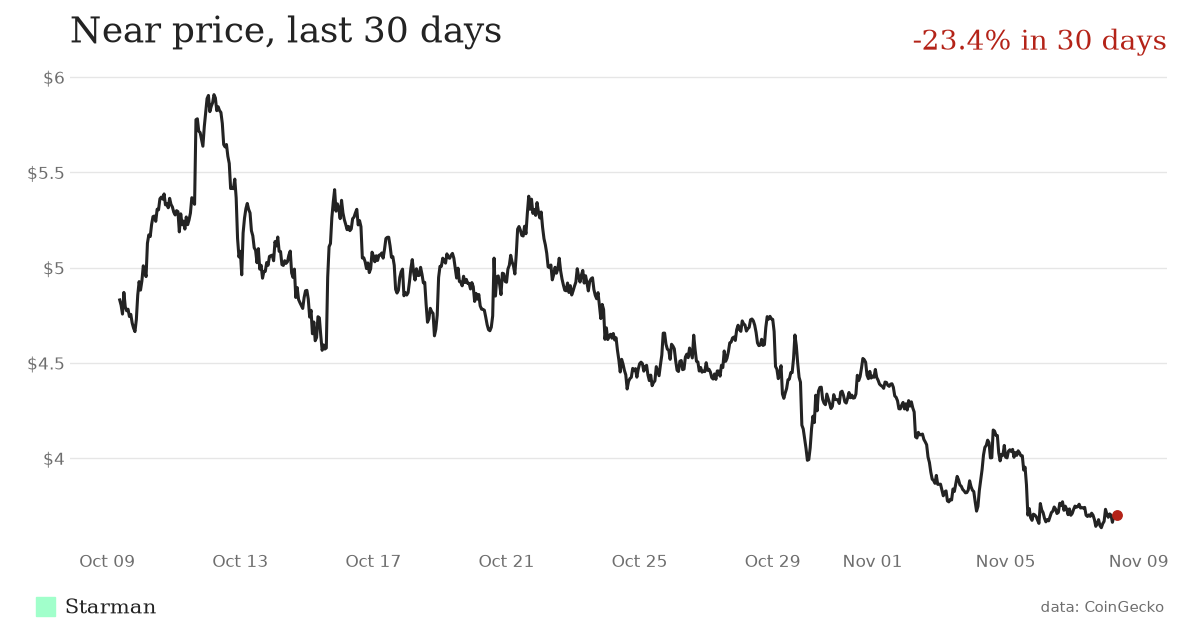
NEAR fell 15.74% in seven days to $3.69, and that drop is why it’s trending on CoinGecko. So what is NEAR Protocol? It’s a proof-of-stake Layer 1 that splits its work across shards, gives users readable account names, and now pitches itself as “the blockchain for AI.” As of November 8, 2026, it ranks 21st by market cap on CoinGecko.
Key takeaways
- NEAR traded at $3.69 on November 8, 2026, down 15.74% over 7 days and 23.71% over 30 days, according to CoinGecko.
- That 7-day loss was the worst in CoinGecko’s top 20. Over the same week Bitcoin fell 2.62% and Ether 1.47%.
- CoinGecko lists 1,311,114,697 NEAR in circulation against a total supply of 1,311,140,199, with no max supply.
- NEAR’s validator docs set the yearly reward budget at 2.5% of total supply, with 90% going to validators and 10% to the protocol treasury.
Why is NEAR trending this week?
Because it dropped harder than its neighbors, not because of a rally. I looked for a specific trigger and didn’t find one. None of the 40 headlines we pulled from CoinDesk, Cointelegraph, Decrypt and Bitcoin Magazine for November 6 and 7 mention NEAR, so any catalyst story would be a guess. I’m not going to invent one.
Here’s how NEAR’s week compares with the bigger names and with Stellar, the other trending coin:
| Coin | 7-day change (as of Nov 8, 2026) |
|---|---|
| NEAR | -15.74% |
| Stellar | -10.85% |
| Cardano | -6.69% |
| Solana | -6.62% |
| Bitcoin | -2.62% |
| Ether | -1.47% |
The whole market was soft too. Total crypto market cap sat at $2.56 trillion, down 2.88% in 24 hours. Big red candles send people to CoinGecko to look things up, and that search traffic alone can push a coin onto the trending list.
One loose thread: NEAR markets itself as an AI chain, and Decrypt reported that AI chip stocks bounced on Friday after a “historic selloff.” It’s tempting to blame NEAR’s slide on a cooling AI trade. Nothing in the data confirms that link, so treat it as a hunch.
What is NEAR Protocol, in plain terms?
NEAR is a general-purpose smart contract platform, in the same broad category as Ethereum, Solana or Cardano. Developers deploy apps on it, users pay small fees in NEAR to use them, and validators who stake NEAR keep the network running.
CoinGecko’s description leans hard into AI. It calls NEAR an “AI-native platform” built from three parts: user-owned AI, intents and chain abstraction, and a sharded blockchain. Strip away the branding and the base layer is still a fast, cheap Layer 1. The AI and cross-chain pieces are products built on top.
How does NEAR sharding (Nightshade) work?
NEAR’s scaling design is called Nightshade. Instead of making every validator process every transaction, the network spreads accounts across shards that run in parallel. Each shard produces a “chunk,” and NEAR’s data flow documentation describes a block as the collection of chunks from all shards.
You still get one chain with one block history. The work inside each block is just split up. When an account on one shard sends tokens to an account on another, the transfer travels as a “receipt” and executes on the receiver’s shard, which is why some NEAR actions settle over two or more blocks.
Speed is the pitch. The epoch docs say an epoch lasts 43,200 blocks, ideally about 7.2 hours. That works out to a block roughly every 0.6 seconds. The gas rules cap each chunk at 1,000 Tgas, about one second of compute, so one heavy contract call can’t hog a shard.
What makes NEAR accounts different from Ethereum?
On Ethereum your address is a long hex string. On NEAR you can have a named account like alice.near, which the account model docs describe as simple to remember and share. There are also implicit accounts (64-character strings derived from an ed25519 key) and Ethereum-like accounts controlled by Ethereum wallets.
The bigger deal is access keys. One account can hold several keys with different permissions: a FullAccess key that can do anything, and FunctionCall keys limited to calling contracts. In practice an app can hold a limited key for you, so you don’t approve every tiny action, while your main key stays in your wallet.
I like this design. It’s one of the few things in crypto that genuinely makes onboarding less painful. The trade-off is that you have to keep track of which keys you’ve handed out.
What is the NEAR token used for?
NEAR’s token documentation lists three jobs for the coin:
- Paying for gas. Every transaction burns gas paid in NEAR. At the price floor of 0.0001 NEAR per Tgas, a plain transfer costs about 0.000045 NEAR, according to the gas docs.
- Locking up storage. Contracts must hold NEAR in proportion to the data they keep on chain, set at 1 NEAR per 100 KB in the storage staking docs. An account gets 770 bytes without staking, covered by a fixed 0.007 NEAR charge at creation.
- Securing the network. Holders delegate NEAR to validators and share in the rewards those validators earn.
One fee rule changed recently. The gas docs say contracts used to receive 30% of the gas they burned, a rebate meant to reward developers. From protocol version 87 (nearcore 2.14.0), that rebate ends and all of it is burned.
Does NEAR have a max supply?
No. Here are the supply and price figures from CoinGecko as of November 8, 2026:
| Metric | Value |
|---|---|
| Price | $3.69 |
| Market cap rank | #21 |
| Circulating supply | 1,311,114,697 NEAR |
| Total supply | 1,311,140,199 NEAR |
| Max supply | None (no hard cap) |
| All-time high | $20.44 (January 16, 2022) |
| 7-day / 30-day change | -15.74% / -23.71% |
| 1-year change | +38.83% |
Circulating and total supply are nearly identical, a gap of about 25,500 tokens. By CoinGecko’s count there isn’t a big locked pile waiting to unlock, which removes one of the most common risks with younger tokens.
The flip side is the missing cap. The validator docs set the yearly reward budget at 2.5% of total supply, 10% to the protocol treasury and 90% to validators. Burned fees push the other way, but with fees this small per transaction, it would take a lot of activity for burning to cancel out issuance.
What are the risks of NEAR?
NEAR has real engineering behind it. There are still honest reasons to be careful:
- At $3.69 it trades at less than a fifth of its $20.44 all-time high from January 2022, yet it’s up 38.83% over one year. It swings hard in both directions.
- Money and users mostly sit elsewhere. NEAR isn’t in DefiLlama’s top 10 chains by DeFi TVL, where Ethereum leads with about $43.3 billion and Base, Solana, BSC and Tron each hold over $5 billion. Tenth place, Monad, has about $949 million.
- The AI story is crowded. Plenty of chains and tokens are chasing AI agents, and a narrative can fade long before the tech catches up.
- CoinGecko tags NEAR with “Alleged SEC Securities” and “FTX Holdings.” Those are labels, not court rulings, but they hint at regulatory overhang, and the second reflects that FTX once held NEAR.
What I’d watch next on NEAR
Three things. First, whether NEAR keeps falling faster than Bitcoin and Ether, which would point to something NEAR-specific rather than the broad market. Second, whether any actual news turns up, because right now our feeds have none.
Third, and most important to me, whether NEAR Intents turns into real usage. It lets a user or AI agent state an outcome, like swapping one token for another, while solvers compete to fill it and a contract on NEAR settles the result. If that shows up in fees and DeFi TVL, it’s the strongest case for the token. If it stays an announcement, the AI branding won’t carry much weight.
None of this is financial advice, so do your own research before you put money into NEAR or any other coin.
FAQ
Is NEAR Protocol a Layer 1 or a Layer 2?
NEAR is a Layer 1. It runs its own proof-of-stake network with its own validators instead of settling onto another chain the way Ethereum rollups do. It scales by sharding internally with its Nightshade design.
How much does a NEAR transaction cost?
Very little. NEAR’s gas docs put a plain transfer at about 0.000045 NEAR at the price floor of 0.0001 NEAR per Tgas. Contracts that store data also have to lock NEAR, at 1 NEAR per 100 KB.
How does NEAR staking work?
You delegate NEAR to a validator and share in the rewards it earns. NEAR’s docs estimate validator yield at about 2.25% times total supply divided by total stake, so the rate drops as more NEAR gets staked. Staked tokens aren’t slashed, but validators with poor uptime earn reduced or zero rewards for that epoch.
Why is NEAR down this week?
There was no NEAR-specific news in the major crypto headlines from November 6 and 7, 2026. The token fell 15.74% over seven days while total market cap dipped 2.88% in 24 hours. Without a clear catalyst, I’d be suspicious of anyone offering one neat explanation.
Related reading
This article is for information only and is not financial advice. Crypto assets are volatile; you can lose all of your money.