
6 min read
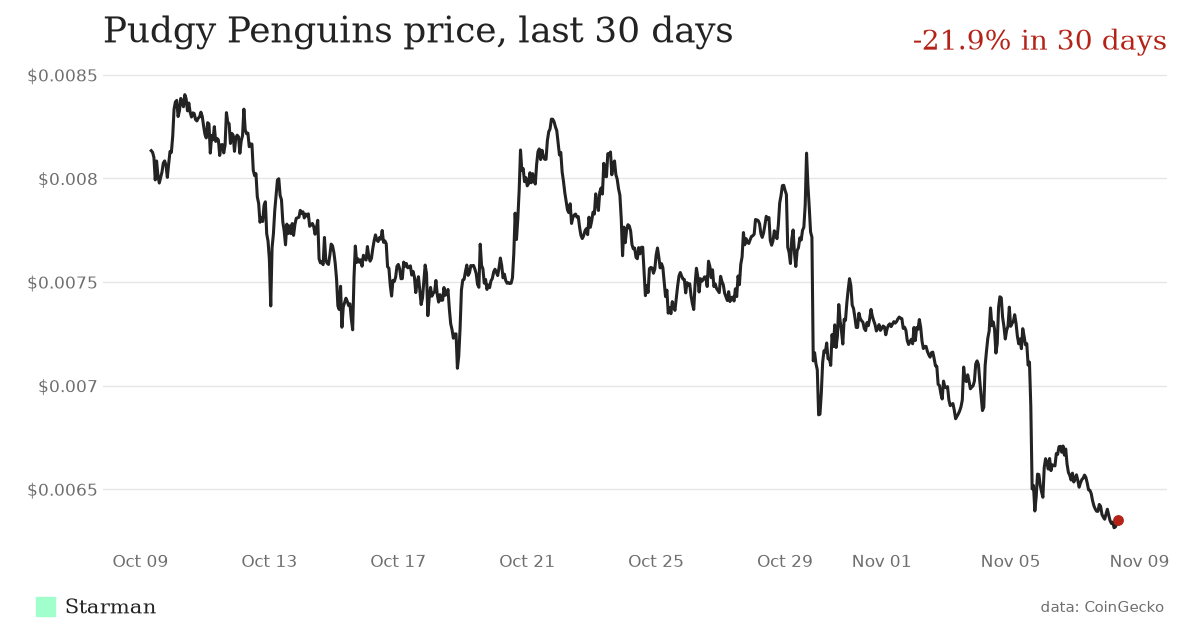
PENGU coin trades at about $0.0063 on November 8, 2026, roughly 91% below its December 2024 peak. It’s the official token of Pudgy Penguins, the cartoon penguin NFT brand. It launched on Solana in December 2024 as a community airdrop, and holders get no equity, no dividends and no voting rights.
Right now it sits second on CoinGecko’s trending list, just behind Bitcoin. The short version: PENGU is a brand token, so its price follows how much people care about the penguin, not any cash flow.
Key takeaways
- PENGU traded at $0.00631704 on November 8, 2026, ranked #115 by market cap on CoinGecko.
- CoinGecko shows 62.86 billion PENGU circulating out of a max supply of 88,888,888,888, about 70.7% of the cap.
- PENGU fell 13.45% over 7 days, 22.64% over 30 days and 58.73% over a year, per CoinGecko.
- The project’s MiCA white paper (October 21, 2025) lists about 8.27 billion PENGU kept by the issuer, roughly 9.3% of max supply.
What is PENGU coin, exactly?
Pudgy Penguins started as an Ethereum NFT collection in 2021. The project’s own MiCA white paper (version 1.0, dated October 21, 2025) lays out what came next: Pudgy Toys and the Pudgy World platform in 2023, PENGU on Solana in 2024, then a YouTube series and iOS games in 2025.
According to that filing, the token is meant to be a cheaper way into the brand than buying an NFT. The issuer is Simple Action Limited, a British Virgin Islands company formed in 2019. By its own account it has no current employees, and it covers its costs with PENGU set aside for operations.
The CoinGecko listing calls PENGU “a symbol for community, memes, and good vibes.” I like that they’re upfront about it. That’s a memecoin description, and I’d treat PENGU as a memecoin, even though the brand behind it is bigger than most.
Which blockchain is PENGU on?
Solana is its main home, where it’s a standard SPL token. The white paper also lists contracts on Ethereum and BNB Smart Chain (the same address on both), on Abstract (an Ethereum layer-2) and on Hyper EVM. CoinGecko puts it in the Solana, Ethereum, BNB Chain and Hyperliquid ecosystems.
The NFTs stay on Ethereum. So the brand lives on one chain while most of the token trading happens on another. Plenty of projects work this way, and it still catches people out.
One habit worth building: when you withdraw PENGU from an exchange, check which network it’s going out on and make sure your wallet supports that exact network. Sending on the wrong network is one of the most common ways people lose tokens for good.
What can you actually do with PENGU?
Not much, and the project says so. The white paper states that PENGU doesn’t meet the EU’s definition of a utility token, because it gives no exclusive access to anything the issuer sells. Buyers get no contractual rights and no claim against any company.
The uses it does list are small:
- Joining partner reward programs. Lufthansa’s Miles & More is named as one integration.
- Getting into some branded digital goods and community experiences.
- Paying at some businesses and partners, which the document says can change over time.
I wouldn’t skip past that last caveat. Whatever utility exists is there because partners choose to keep offering it. The filing also calls PENGU non-interest-bearing, with no burn or elastic supply mechanism that responds to demand.
PENGU coin supply and market cap
These are CoinGecko’s numbers as of November 8, 2026. I worked out the market cap and fully diluted value myself from the price and supply figures.
| Metric | Value |
|---|---|
| Price | $0.00631704 |
| Market cap rank | #115 |
| Circulating supply | 62.86 billion PENGU |
| Total supply | 76.72 billion PENGU |
| Max supply | 88,888,888,888 PENGU |
| Market cap (price x circulating) | about $397 million |
| Fully diluted value (price x max) | about $562 million |
| All-time high | $0.068447 (December 17, 2024) |
About 70.7% of the max supply is already circulating. That leaves roughly 26 billion tokens that can still hit the market, worth around $164 million at today’s price.
The white paper says any new supply follows a predefined issuance and unlock schedule. But neither the paper nor CoinGecko’s summary gives dates. I’d look up a token unlock tracker before assuming that overhang won’t matter.
The same filing lists about 8.27 billion PENGU as retained by the issuer, roughly 9.3% of max supply. That’s normal for a branded token. It’s still a lot of tokens sitting with one entity.
Why is PENGU trending this week?
Honestly, the trigger isn’t clear. CoinGecko’s trending list is based on search activity on the site, so trending means people are looking, not that they’re buying. I checked this week’s headlines from CoinDesk, Cointelegraph, Decrypt and Bitcoin Magazine and didn’t find a single PENGU-specific story.
What the data does show is a falling price. Steep drops send people searching just as often as rallies do.
| Measure | PENGU | Bitcoin / market |
|---|---|---|
| Price | $0.00631704 | $75,734 |
| 7-day change | -13.45% | n/a |
| 30-day change | -22.64% | -7.86% |
| 1-year change | -58.73% | n/a |
| Distance from all-time high | about -91% | n/a |
| Total crypto market cap | $2.56 trillion, down 2.88% in 24 hours | |
The wider market isn’t helping either. CoinDesk reported that over $1 billion in bullish bets were liquidated on Friday. Memecoins usually fall harder than Bitcoin in weeks like this one, and PENGU’s 30-day loss is close to three times Bitcoin’s.
What are the real risks of holding PENGU?
I’d be careful here, and for reasons specific to this token.
First, nothing sits behind it. If Pudgy Toys sell well or a new game takes off, PENGU holders get no share of that. The token can only benefit indirectly, through attention.
Second, brand growth and token price have gone separate ways. The brand added toys, games and media over the same period PENGU lost about 91% from its high. A popular mascot didn’t protect the chart, and I wouldn’t count on it doing so next time.
Third, supply. Around 26 billion more tokens can still come into circulation, and about 8.27 billion sit with the issuer. Nobody has to act in bad faith for that to drag on price. Ordinary scheduled unlocks are enough.
Fourth, where you keep it. Exchange access differs by country and can change quickly. This week CoinDesk reported that Binance users in some European countries were told to pull their crypto before fees kick in, with accounts closing by year end. That story has nothing to do with PENGU specifically. It’s a reminder that a token you can trade today might need moving tomorrow, and rushed moves are when wrong-network mistakes happen.
What I’d watch next with PENGU
If PENGU is on your radar, I’d keep an eye on three things:
- The unlock schedule for the remaining supply. It’s the most concrete source of price pressure.
- Whether partner programs like Miles & More turn into regular use or stay a press-release feature.
- How PENGU moves against Bitcoin if the broader market settles down. A memecoin that keeps lagging in a calm market is telling you something.
In the EU, the white paper was filed to support trading on OKCoin Europe, with November 12, 2025 listed as the start date. That gives European buyers a regulated venue. A disclosure document isn’t an endorsement, though, and the paper says so itself.
This is not financial advice. Do your own research, and don’t put in money you couldn’t stand to watch fall 90%, because this token has already done that once.
FAQ
Is PENGU the same as a Pudgy Penguins NFT?
No. The NFTs are separate collectibles on Ethereum, while PENGU is a fungible token that mostly trades on Solana. PENGU was airdropped to the community, and the project pitches it as a cheaper way to join the brand.
What blockchain is PENGU on?
Solana is the main network, using the SPL token standard. The project also lists contracts on Ethereum, BNB Smart Chain, Abstract and Hyper EVM. Always match the network when you send or withdraw.
What is the max supply of PENGU?
The max supply is 88,888,888,888 PENGU. As of November 8, 2026, CoinGecko shows 62.86 billion circulating and a total supply of 76.72 billion, so about 70.7% of the cap is in circulation.
Does PENGU pay staking rewards or dividends?
The white paper describes PENGU as non-interest-bearing, with no dividends, ownership rights or governance votes in any company. Some platforms may run their own reward programs, but those rewards come from the platform, not from the token.
Related reading
This article is for information only and is not financial advice. Crypto assets are volatile; you can lose all of your money.