7 min read
An S&P 500 index fund tracks the index, down 5.0% in a month to 7,376.86 per Yahoo Finance. It holds the roughly 500 large US companies in the S&P 500, in the same proportions, so one purchase gives you a slice of all of them. You don’t pick winners. You accept the market’s return, minus a small fee, and that’s the whole point.
Key takeaways
- The S&P 500 closed at 7,376.86 on November 6, 2026, down 5.0% over one month and 4.91% over three months (Yahoo Finance).
- The tech-heavy Nasdaq Composite fell 9.61% over the same month while the Dow Jones gained 0.11% (Yahoo Finance), which shows how much big tech names move the S&P.
- US CPI inflation was 3.74% year over year in September 2026 (Bureau of Labor Statistics), so cash sitting idle loses buying power.
- The effective fed funds rate was 3.88% on November 5, 2026 (New York Fed), which sets the bar that cash alternatives are measured against.
What is an S&P 500 index fund, in plain terms?
The S&P 500 is a list, maintained by S&P Dow Jones Indices, of about 500 large US companies. A fund that tracks it simply buys those companies. Nobody at the fund is trying to guess which stock will do best next quarter.
The list is weighted by market value. A company worth ten times more than another gets roughly ten times the weight in your fund. That detail matters more than most beginners realize, and I’ll come back to it.
When people search for a “Fidelity 500 index fund” or a “Vanguard index fund”, they’re usually looking at different wrappers around the same idea. Many big fund companies offer one. The holdings are nearly identical. What differs is the fee, the minimum to get started, and whether it’s a mutual fund or an ETF.
How does an S&P 500 index fund work?
You hand the fund money. The fund buys the 500 stocks in index proportions. When the index changes its members, the fund follows. When the companies pay dividends, the fund collects them and either pays them to you or reinvests them, depending on your settings.
Your return is close to the index return, minus the expense ratio. The expense ratio is an annual percentage the fund takes out of its assets. You never see a bill. It just quietly shaves your balance.
Mutual fund or ETF version?
Both can track the same index. An ETF trades on an exchange all day like a stock. A mutual fund prices once a day after the market closes, and some have a minimum first purchase. In a regular taxable account, ETFs have historically tended to distribute fewer capital gains, though that varies by fund. For most people, the fee and the account you hold it in matter more than the wrapper.
What does a 5% drop do to $10,000?
Simple numbers help here. Say you’d put $10,000 into an S&P 500 index fund a month ago. The index price fell 5.0% over that month (Yahoo Finance), so your stake would be worth about $9,500, before counting any dividends the fund paid.
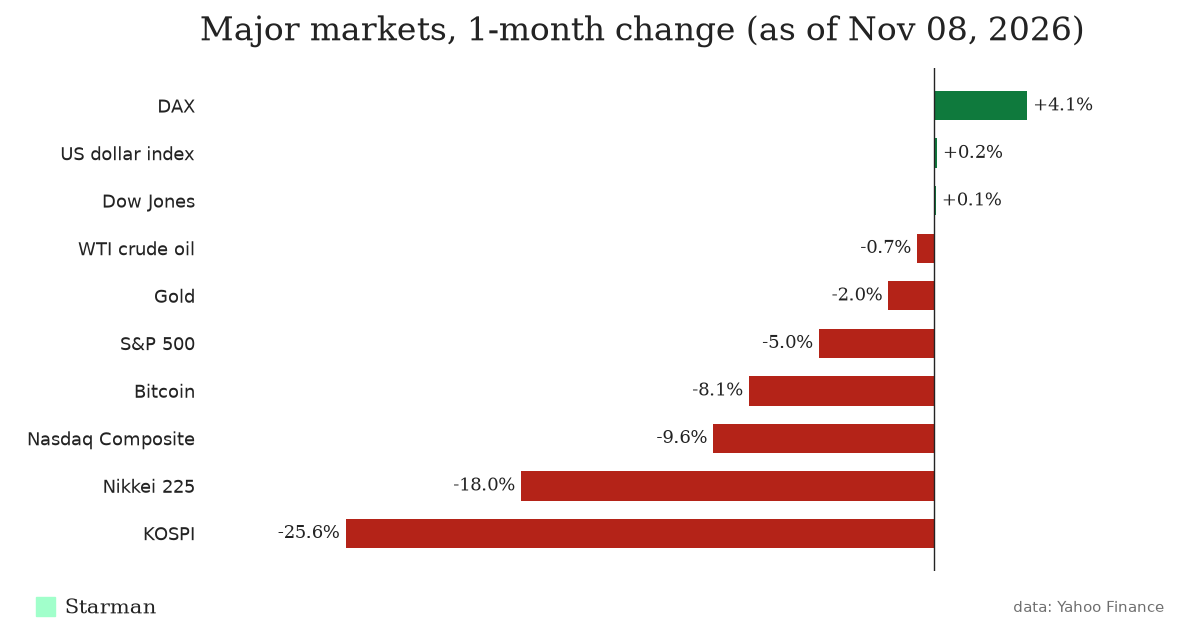
Compare that to the other big indexes over the same month, all from Yahoo Finance data as of November 6, 2026:
| Index or asset | Last | 1 day | 1 month | 3 months |
|---|---|---|---|---|
| S&P 500 | 7,376.86 | +0.31% | -5.00% | -4.91% |
| Nasdaq Composite | 24,579.43 | +1.09% | -9.61% | -7.91% |
| Dow Jones | 51,285.73 | -0.46% | +0.11% | -5.09% |
| Nikkei 225 | 57,434.77 | -5.96% | -17.99% | -12.56% |
| KOSPI | 5,059.69 | -6.02% | -25.64% | -19.64% |
| Bitcoin (Nov 8) | $75,876 | +0.17% | -8.08% | +16.90% |
The gap between the Nasdaq and the Dow tells you something. The Nasdaq is packed with tech, the Dow barely moved, and the S&P landed in between. Because the S&P is weighted by size, its largest tech companies pull it harder than the other few hundred names combined. You own “500 companies”, but a handful drive a big share of the result.
Investing a fixed amount every month
Most people don’t drop in a lump sum. They invest the same amount each month. Here’s a made-up three-month example with $500 a month:
- Month 1, fund price $100: you get 5.000 shares
- Month 2, price falls to $95: you get 5.263 shares
- Month 3, price recovers to $105: you get 4.762 shares
You’ve put in $1,500 for 15.025 shares, an average cost of about $99.83. The dip month bought you the most shares. That’s why steady buyers can treat a month like this one as less scary than it feels.
How much do index fund fees actually cost?
Take two hypothetical funds tracking the same index. Fund A charges $5 a year per $10,000. Fund B charges $75 per $10,000. Same stocks, same index, and Fund B costs fifteen times more every single year.
The real damage is that the fee money stops compounding for you. Over decades, a high fee on a fund that holds the exact same stocks is the most avoidable loss in investing. You can check any fund’s current expense ratio on its fact sheet or prospectus, on the provider’s website. I’d look there before anything else.
What mistakes do people make with S&P 500 funds?
Selling in a down month is the big one. Years ago I sold an index fund during a scary stretch and bought back higher a few months later. That single decision cost me more than every fee I’ve ever paid. A 5.0% monthly drop like this one is normal behavior for stocks, not a signal.
Owning the same thing three times is another. An S&P 500 fund, a “total US market” fund and a “large-cap growth” fund overlap heavily. You think you’re diversified, but you’ve mostly bought the same big tech names in triplicate.
Assuming it covers the world is a third. It’s US companies only. This month shows why that cuts both ways: Japan’s Nikkei 225 fell 17.99% and Korea’s KOSPI fell 25.64% over the month, while Germany’s DAX rose 4.09% (Yahoo Finance). If you want non-US exposure, that’s a separate fund.
And ignoring taxes. In a regular brokerage account, dividends and gains you realize can be taxed. MarketWatch has a rundown of 2027 capital-gains tax rates by income level, but your own situation is what counts, so confirm with the IRS or a tax professional.
Is now a good time to buy an index fund?
Nobody knows where the S&P goes next month, and I won’t pretend to. What I can do is lay out the backdrop. The US economy added 165,000 jobs in October against a 65,000 estimate, according to CoinDesk. Unemployment was 4.1% in October (Bureau of Labor Statistics).
At the same time, inflation is still running at 3.74% (BLS, September) and the 10-year Treasury yield sits at 4.86% (Yahoo Finance). Higher yields give savers a real alternative to stocks and can weigh on richly valued tech names, which fits with the Nasdaq’s 9.61% monthly drop. Even Berkshire Hathaway more than doubled its buybacks in the third quarter, per CNBC, which tells you at least one famously cautious buyer saw value in its own shares.
My view: timing is the wrong question for a fund you plan to hold for years. The better question is whether you have an emergency fund first, so you’re never forced to sell in a month like this.
If you also hold crypto, compare the volatility. Bitcoin fell 8.08% in a month but is up 16.9% over three (Yahoo Finance), a much wilder ride, as I covered in this week’s crypto market recap. And if you’ve seen “tokenized” versions of stock funds on crypto exchanges, read why tokenized stocks just dropped first. The tokenized ETF category fell 14.34% in a single day on crypto market data, which is not how a plain index fund at a regular brokerage behaves.
FAQ
Is an S&P 500 index fund good for beginners?
It’s one of the simplest ways to own a broad slice of the US stock market, with low costs and no stock picking. It still falls when stocks fall, as the 5.0% monthly drop to November 6 shows. It suits money you won’t need for several years.
Can you lose money in an S&P 500 index fund?
Yes. The fund’s value moves with the index, and stock markets have had long, deep declines in the past. Over short periods losses are common. Diversification across 500 companies protects you from one company failing, not from the whole market falling.
What’s the difference between an S&P 500 ETF and a mutual fund?
Both can hold the same stocks. ETFs trade during market hours like a stock, while mutual funds price once a day and may have a minimum first purchase. Compare the expense ratio and any trading costs at your brokerage before choosing.
How much money do I need to start?
It depends on the fund and your brokerage. Some mutual funds set a minimum first investment, while many brokerages let you buy ETFs in fractional shares with small amounts. Check the fund’s page or your brokerage for the current minimum.
What I’d watch next
Three things. First, whether the Nasdaq’s 9.61% slide keeps dragging the S&P, since a few big tech names carry so much of its weight. Second, the next CPI reading against September’s 3.74%, because sticky inflation keeps yields like the 4.86% 10-year elevated. Third, the Fed, with the effective rate at 3.88%.
If I were starting today, I’d spend my energy on the boring parts: the lowest fee I can find for the same index, the right account, and an automatic monthly amount I won’t touch in a bad month. This is not financial advice, so do your own research before you invest.
Related reading
This article is for information only and is not financial advice. Crypto assets are volatile; you can lose all of your money.