
11 min read
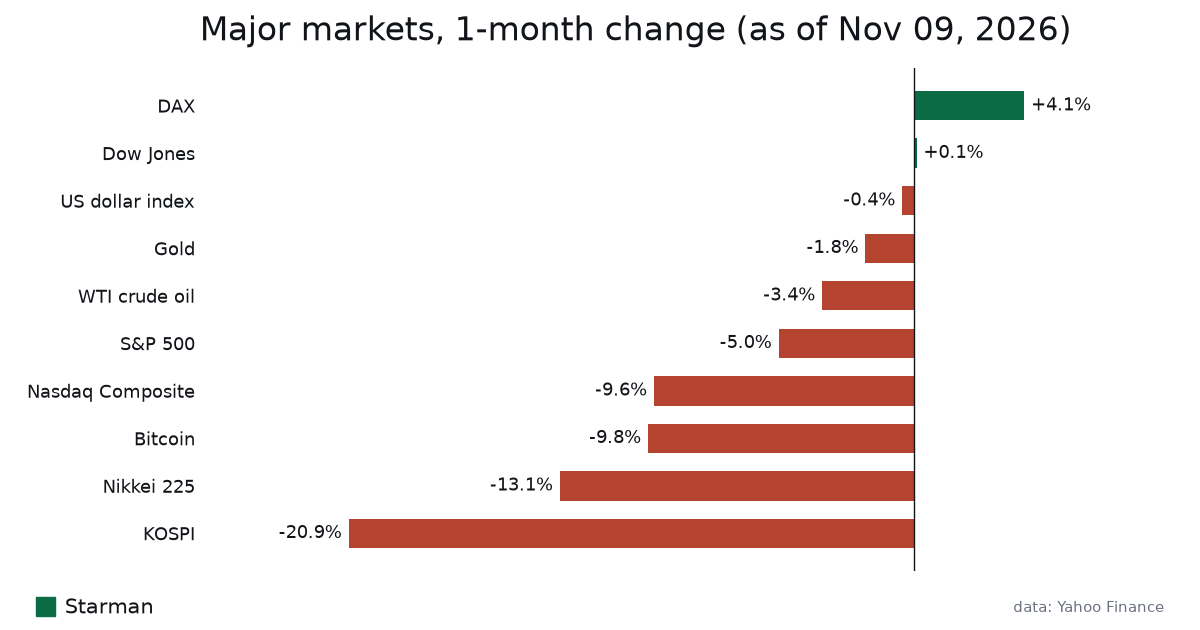
The S&P 500 is down 5.0% over the past month, so most stock-heavy 401k balances are lower too. Yahoo Finance data through November 6, 2026 shows the Nasdaq Composite fell 9.61% over the same month, which means the stock market drop 401k savers are feeling is sharper in plans that lean on growth or tech funds. For most savers with years to go, the dollar loss is smaller than it feels. The bigger risk is what you do next.
Key takeaways
- The S&P 500 closed at 7,376.86 on November 6, down 5.0% over one month and 4.91% over three months (Yahoo Finance).
- The Nasdaq Composite lost 9.61% in a month while the Dow Jones gained 0.11%, so your loss depends heavily on which funds you hold (Yahoo Finance).
- The 10-year Treasury yield fell 7.11% over the month to 4.86%, which tends to lift the price of bond funds (Yahoo Finance).
- US inflation was 3.74% in September 2026 (BLS) and the effective fed funds rate was 3.88% on November 5 (New York Fed), so cash is only just ahead of inflation.
How far have markets fallen this month?
The losses are concentrated in one part of the market. Yahoo Finance figures show the Nasdaq Composite, which is heavy in large technology companies, fell 9.61% over the month to 24,579.43. The Dow Jones Industrial Average rose 0.11% to 51,285.73 over the same period. The S&P 500 landed between the two.
| Market | Last | 1 day | 1 month | 3 months | As of |
|---|---|---|---|---|---|
| S&P 500 | 7,376.86 | +0.31% | -5.00% | -4.91% | Nov 6 |
| Nasdaq Composite | 24,579.43 | +1.09% | -9.61% | -7.91% | Nov 6 |
| Dow Jones | 51,285.73 | -0.46% | +0.11% | -5.09% | Nov 6 |
| DAX (Germany) | 25,820.36 | -1.92% | +4.09% | -1.22% | Nov 6 |
| Nikkei 225 (Japan) | 58,801.02 | +2.38% | -13.24% | -12.20% | Nov 9 |
| KOSPI (South Korea) | 5,099.50 | +0.79% | -20.12% | -19.05% | Nov 9 |
| Gold (USD/oz) | 4,116.50 | +1.02% | -1.77% | -6.86% | Nov 9 |
| US 10-year yield | 4.86% | +0.45% | -7.11% | +4.05% | Nov 6 |
Source: Yahoo Finance. The yield row shows the percentage change in the yield itself, not in a bond price.
International results are all over the place. Germany’s DAX gained 4.09% over the month, while Japan’s Nikkei 225 fell 13.24% and South Korea’s KOSPI dropped 20.12%. If your 401k has an international index fund, how it did depends on how much it owns in Asia compared with Europe. The fund’s fact sheet will tell you.
Look at the one-day column too. On November 6 the S&P 500 rose 0.31% and the Nasdaq 1.09%. A single green day doesn’t end a slide, but rebounds usually arrive with no warning, and that matters if you’re thinking about stepping aside.
How a stock market drop affects your 401k, step by step
A 401k is a wrapper. The tax treatment comes from the account, and the gains and losses come from the funds inside it. This is the order in which a selloff reaches you:
- Your plan holds units of mutual funds or collective trusts. When the stocks inside a fund fall, its price (net asset value) is recalculated at the market close, and your balance updates with it.
- Nothing gets sold unless you sell it. A paper loss only becomes permanent if you exchange out of the fund or withdraw the money.
- Every paycheck buys at the new, lower price. You contribute a fixed dollar amount, so cheaper units mean more of them. After a 5% fall, the same dollars buy about 5.3% more shares (1 divided by 0.95).
- Any employer match is invested the same way, so the match also buys more units while prices are down.
- If you hold a target-date fund, the manager rebalances for you. When stocks fall below the fund’s target weight, it shifts money from bonds into stocks to get back to its planned mix.
Most 401k menus are built around a large-cap US index fund. I explained how that kind of fund is put together, and why its biggest holdings drive its moves, in how an S&P 500 index fund works.

What a 5% drop means for a $50,000 401k
Let’s put dollars on it. Say your balance was $50,000 a month ago and your bond slice stayed flat. That’s a conservative assumption, because bond yields fell this month and bond prices usually rise when that happens.
| Your mix (on $50,000) | Stock portion | One-month index move | Dollar loss | New balance | Overall change |
|---|---|---|---|---|---|
| 100% S&P 500 fund | $50,000 | -5.00% | $2,500 | $47,500 | -5.0% |
| 70% S&P 500 fund, 30% bonds | $35,000 | -5.00% | $1,750 | $48,250 | -3.5% |
| 70% Nasdaq-style growth fund, 30% bonds | $35,000 | -9.61% | $3,363.50 | $46,636.50 | -6.7% |
| 70% Dow-style value fund, 30% bonds | $35,000 | +0.11% | +$38.50 | $50,038.50 | +0.1% |
Index moves from Yahoo Finance, one month to November 6, 2026. Real funds won’t match an index exactly.
On a $10,000 slice, a 5% fall costs $500 and a 9.61% fall costs $961. That’s the difference between a broad index fund and a tech-heavy one, in a single month.
Compare that with how much you put in. If you contribute $500 a month, the $1,750 loss in the 70/30 example equals three and a half months of contributions. That hurts, but someone with 20 years of contributions ahead can absorb it. Someone retiring next spring is in a very different spot, and should look closely at how much of the balance sits in stocks.
Why your bond fund may be helping while stocks fall
Over the month the 10-year Treasury yield dropped 7.11% in relative terms, ending at 4.86% on November 6 (Yahoo Finance). Bond prices move opposite to yields, so an intermediate-term bond fund in your plan has probably held up or gained a little. The exact gain depends on the fund’s duration, and you’ll see it on your statement.
That’s the reason a 60/40 or 70/30 mix exists. In the worked example above, the bond slice did nothing at all and still cut the loss from 5.0% to 3.5%.
There’s a caveat. Over three months the 10-year yield went up 4.05%, which means bond prices were falling for part of that stretch. Bonds don’t hedge stocks every time, particularly when inflation is high. September CPI inflation was 3.74% (BLS), and when inflation stays high, stocks and bonds can fall together.
Gold wasn’t a safe haven either. It fell 1.77% over the month and 6.86% over three months to $4,116.50 an ounce (Yahoo Finance). Few 401k menus offer gold anyway, but people who expected it to rise in a selloff were disappointed this time.
Has the market dropped like this before, and what happened next?
Yes, many times, and some drops were far worse than 5%. In the 2008 to 2009 financial crisis, the S&P 500 took years to get back to its 2007 peak. In March 2020, the pandemic crash was one of the fastest bear markets on record, and the index was back at new highs before the year ended.
In both cases the savers who came out ahead had something in common: they kept contributing through the low point. Their paychecks bought shares at depressed prices. People who switched to cash had a second problem, because they had to pick a day to get back in, and most of the rebound happened before it felt safe.
History also has a warning, and it’s in the table above. Japan’s Nikkei 225 peaked in 1989 and took about 35 years to get back above that level. It’s down 13.24% this past month. A single market can stay underwater for decades, which is why a diversified 401k beats one concentrated in a single country or sector.
Nobody knows whether today’s US slide will be short like 2020 or long like 2008. Your mix should be one you can hold either way.
What mistakes do people make with a 401k in a selloff?
I’ve made a couple of these myself in taxable accounts, so I’m not judging. These are the ones that cost the most:
- Moving everything to the cash or stable value option after the market has already fallen. That locks in the 5% loss and leaves you guessing when to return. The 1.09% Nasdaq bounce on November 6 is the sort of day you miss.
- Cutting contributions below the level that gets the full employer match. Turning down the match means losing a return you’d get even if the market went nowhere.
- Taking a hardship withdrawal. It’s taxed as income, and before age 59½ there’s usually a 10% penalty on top. Selling after a drop makes it worse.
- Borrowing from the 401k to “wait it out.” Loan money is out of the market during the recovery, and if you leave your job the remaining balance can come due quickly.
- Not noticing concentration. A large-cap growth fund and an S&P 500 fund often own many of the same big tech names, so a plan that looks diversified may not be. MarketWatch raised this issue this week in The S&P 500 could be dangerously exposed to AI.

Stay, rebalance or go to cash: how the options compare
A 401k gives you only a few choices. Here’s how they compare with the current numbers.
| Option | What happens to your money | Main cost | Usually fits |
|---|---|---|---|
| Keep contributing, change nothing | After a 5% fall, each dollar buys about 5.3% more shares | Balance may keep falling for a while | Long time horizon |
| Rebalance to your target mix | Trims what held up (often bonds) and adds to stocks | Takes discipline; stocks could fall further | Anyone whose mix has drifted |
| Send new contributions to money market or stable value | Earns close to short-term rates; fed funds at 3.88% vs 3.74% inflation | Very little growth after inflation | People close to retirement |
| Move the whole balance to cash | Turns the paper loss into a real one | You have to time your way back in | Rarely a good fit, in my view |
| Loan or hardship withdrawal | Cash in hand now | Taxes, a likely 10% penalty under 59½ on withdrawals, missed recovery | Real emergencies only |
Rates from the New York Fed (EFFR, November 5) and BLS (CPI, September 2026). Money market yields in your plan will be close to the fed funds rate but not identical.
I’d be careful with the cash row. The effective fed funds rate is 3.88% and inflation is 3.74%, so cash earns roughly 0.14 percentage points above inflation before fees. That works for parking money you’ll spend within a year or two. It’s a weak place for retirement money you won’t need for decades.
Is the stock market in a bubble, and what are the risks?
This question is getting a lot of searches right now. I don’t think anyone can answer it with confidence. What the data does show is a selloff focused on the high-growth part of the market: the Nasdaq is down 9.61% for the month while the Dow is flat. CNBC’s coverage this week of the AI selloff, including Cathie Wood’s view that she feels better when the market is worried, shows how divided investors are on whether this is a buying chance or the start of a longer reset.
The economy is sending mixed signals. Unemployment was 4.1% in October (BLS), which isn’t a recession-level number. But inflation at 3.74% is well above the Fed’s 2% goal, and WTI crude has climbed 10.03% over three months to $90.37 a barrel (Yahoo Finance). Expensive oil and sticky inflation make it harder for the Fed to cut rates. Lower rates are one of the things that usually supports stock valuations.
You don’t have to predict the outcome to protect yourself. Ask whether your 401k would be okay if the Nasdaq-heavy part of your plan fell another 10%. If the honest answer is no, your mix is too aggressive for you, whatever the market does next. If you also hold crypto outside your 401k, bitcoin fell 10.01% over the month, so the same check applies there. I covered that market in this week’s crypto market update.
FAQ
Should I stop contributing to my 401k when the stock market drops?
For most people, stopping is the expensive choice. Your contributions buy more shares at lower prices, about 5.3% more after a 5% fall, and you’d also lose any employer match. If you truly need the cash for bills, pause only the part above the match.
How much has my 401k lost this month?
Multiply each fund’s balance by its one-month return. As a rough guide, a broad S&P 500 fund lost about 5.0% in the month to November 6, a tech-heavy growth fund could be closer to the Nasdaq’s 9.61%, and a value or Dow-style fund was roughly flat (Yahoo Finance). Your plan website will show the exact figures.
Is my money safe in a 401k during a crash?
The account itself is held separately from your employer’s business assets, so your employer can’t spend it. The investments inside it can still lose value. “Safe” here means the money belongs to you. It doesn’t mean the balance won’t fall.
Should I move my 401k to a stable value or money market fund?
It depends on when you need the money. Cash-like options currently earn close to the 3.88% fed funds rate, just above 3.74% inflation, so they protect against losses but grow very little. That can make sense for money you’ll withdraw in the next few years. It rarely makes sense for a whole balance with decades left to grow.
Can I borrow from my 401k when the market is down?
Many plans allow loans, but borrowing after a drop means selling fund units at lower prices to fund the loan. That money then misses any recovery. If you leave your job, the outstanding balance may come due soon, and anything unpaid can be taxed as a withdrawal.
How long does it take a 401k to recover from a drop?
Nobody can give you a date. The 2020 crash recovered within months, the 2008 crisis took years, and Japan’s market took decades to regain its 1989 peak. Steady contributions and a diversified mix shorten your personal recovery time, because you keep buying while prices are low.
What I’m watching next for my own retirement account
First, the next BLS inflation report, which will cover October. September’s 3.74% is the number to beat. A lower reading would give the Fed more room to cut rates, and that tends to help both stocks and bonds.
Second, the 10-year yield around 4.86%. If it keeps falling, bond funds keep helping. If it climbs back up, stocks and bonds could fall together, as they partly did over the past three months.
Third, the gap between the Nasdaq and the Dow. A month with a 9.61% loss in one and a 0.11% gain in the other shows a market rotating between sectors more than collapsing. I’ll check whether that gap narrows or widens, and whether the S&P 500 holds near 7,376.
My own plan is boring: keep contributions running, check my mix once on a set date, and rebalance only if it has moved more than a few points from target. This is not financial advice, so do your own research and consider your own timeline before you change anything.
Related reading
This article is for information only and is not financial advice. Crypto assets are volatile; you can lose all of your money.